Articles
Green Chemistry: Principles, Importance & Environmental Protection
Abstract
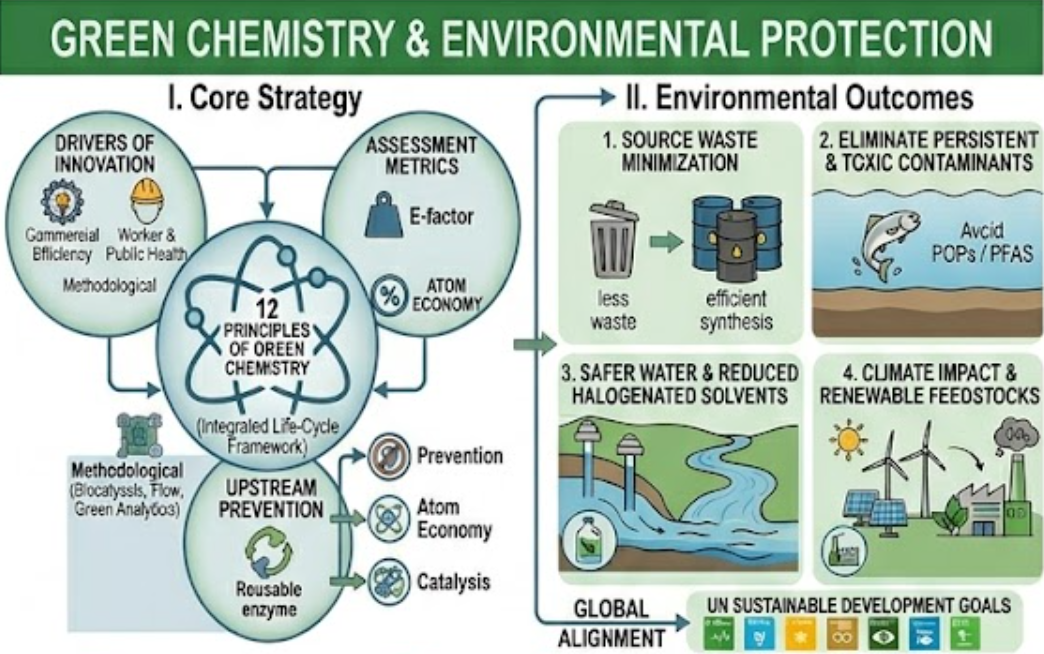
Green chemistry (sustainable chemistry) emerged in the early 1990s as a science-based, preventive response to evidence that conventional chemical production generates persistent pollutants, depletes finite resources, and elevates risks to human and ecosystem health. This chapter aims to synthesise the principles, importance, and environmental-protection functions of green chemistry by critically consolidating the field’s historical development, the 1998 formulation of the twelve principles, subsequent two-decade evaluations of their continued relevance, and sectoral and methodological advances. Using a narrative literature-based analysis supported by established quantitative metrics, the chapter shows that the twelve principles operate as an integrated, hierarchical life-cycle framework spanning feedstock selection, reaction and solvent design, energy use, real-time monitoring, inherent safety, and end-of-life fate. Major findings indicate that upstream prevention (waste avoidance and atom economy) is more efficient and economical than end-of-pipe control, with documented industrial translation in fine chemical and pharmaceutical manufacturing where solvent use and waste burdens (E-factors commonly 25 to >100 kg waste per kg product) can be markedly reduced through route redesign, catalysis, flow processing, and solvent substitution. The principles specifically mitigate groundwater and surface-water contamination by reducing reliance on halogenated solvents, curb climate impacts by lowering energy intensity and enabling renewable feedstocks and biorefinery models, and address legacy hazards by designing less toxic chemicals that degrade rather than persist (e.g., avoiding POP-like behaviours exemplified by DDT, PCBs, and PFAS). Adoption is further driven by worker-safety imperatives, tightening regulation (e.g., REACH and TSCA), and innovation in biocatalysis, mechanochemistry, electrochemistry, and green analytical chemistry. Assessment frameworks (E-factor, PMI, atom economy, DOZN 2.0, GCM, CGCPS, and Cpmₐˣ) operationalise benchmarking and decision-making. Persistent barriers include capital inertia and principle trade-offs requiring systems-level and life-cycle thinking, alongside underrepresentation in curricula, motivating education and capacity-building—particularly in the global south—and future integration with circular-economy stewardship and AI-enabled optimisation aligned with multiple UN SDGs.
Most read articles by the same author(s)
- Kuldeep Singh, Raman Singh, Introduction , RSYN PRESS: No. 9788198623140 (2025): Water Chemistry: Principles, Analysis, and Environmental Applications
- Kuldeep Singh, Raman Singh, Ethics, Risks and Responsible Innovation , RSYN PRESS: No. 978-81-986231-5-7 (2025): Exploring Innovation in Technology and Society
- Aarti Dwivedi, Raman Singh, Kuldeep Singh, Preface , RSYN PRESS: No. 978-81-986231-7-1 (2026): Selected Experiments in Chemistry
- Aarti Dwivedi, Raman Singh, Kuldeep Singh, Introduction: Essential Laboratory Skills , RSYN PRESS: No. 978-81-986231-7-1 (2026): Selected Experiments in Chemistry
- Aarti Dwivedi, Raman Singh, Kuldeep Singh, Fundamental Concepts of Analytical Chemistry , RSYN PRESS: No. 978-81-986231-7-1 (2026): Selected Experiments in Chemistry
- Aarti Dwivedi, Raman Singh, Kuldeep Singh, Quantitative Volumetric Analysis and Data Integrity , RSYN PRESS: No. 978-81-986231-7-1 (2026): Selected Experiments in Chemistry
- Aarti Dwivedi, Raman Singh, Kuldeep Singh, Standardisation of NaOH Solution and Determination of the Strength of a Given HCl Solution , RSYN PRESS: No. 978-81-986231-7-1 (2026): Selected Experiments in Chemistry
- Aarti Dwivedi, Raman Singh, Kuldeep Singh, Determination of Chloride Content in Water by Mohr's Method , RSYN PRESS: No. 978-81-986231-7-1 (2026): Selected Experiments in Chemistry
- Aarti Dwivedi, Raman Singh, Kuldeep Singh, Preparation of Bakelite (Phenol-Formaldehyde) Resin , RSYN PRESS: No. 978-81-986231-7-1 (2026): Selected Experiments in Chemistry
- Aarti Dwivedi, Raman Singh, Kuldeep Singh, Determination of Total, Temporary, and Permanent Hardness of Water Using EDTA , RSYN PRESS: No. 978-81-986231-7-1 (2026): Selected Experiments in Chemistry
Similar Articles
- Anjali Vishwakarma, Rainsica Kori, Dharmendra Jain, Converging Green Chemistry and Nanotechnology for Next-Generation Materials , RSYN PRESS: No. 978-81-998593-2-6 (2026): Smart Pharmaceutics: Integrating Computational Intelligence, Nanomedicine, and Green Chemistry
- Kuldeep Singh, Raman Singh, Introduction , RSYN PRESS: No. 9788198623140 (2025): Water Chemistry: Principles, Analysis, and Environmental Applications
- Front Matter , RSYN PRESS: No. 978-81-998593-4-0 (2026): Utility of Indian Knowledge Tradition in Human Life
- Deepak Kumar Yadav, Afaroj Alam, Dharmendra Jain, Artificial Intelligence Innovation in Alzheimer's Disease Care, Diagnosis, Treatment, and Integration , RSYN PRESS: No. 978-81-998593-2-6 (2026): Smart Pharmaceutics: Integrating Computational Intelligence, Nanomedicine, and Green Chemistry
- Abhishek Soni, Aashi Jain, Dharmendra Jain, AI in Pharmaceutical Nanotechnology: Current Advances and Future Prospects , RSYN PRESS: No. 978-81-998593-2-6 (2026): Smart Pharmaceutics: Integrating Computational Intelligence, Nanomedicine, and Green Chemistry
- Aniket Kumar, Dharmendra Jain, Molecular Docking: Paving the Path for Next-Generation Drug Discovery , RSYN PRESS: No. 978-81-998593-2-6 (2026): Smart Pharmaceutics: Integrating Computational Intelligence, Nanomedicine, and Green Chemistry
- Aarti Dwivedi, Raman Singh, Kuldeep Singh, Fundamental Concepts of Analytical Chemistry , RSYN PRESS: No. 978-81-986231-7-1 (2026): Selected Experiments in Chemistry
You may also start an advanced similarity search for this article.